 Posted by
Romanian version of this article here.
Professor David calls astrology obscurantism. But sometimes skepticism toward astrology is itself archetypal, not just science being rigorous. Richard Tarnas named it The Ideal and the Real: the Saturn–Neptune polarity. One impulse is about spirit; the other tears it down for certainty. Both legitimate, neither “right.”
Which is why David’s crusade against astrology matters beyond politics. The coherence is hard to ignore, look at his natal chart, transits, and the timing of events, synchronized with the collective Saturn–Neptune cycle. It’s just what astrology always promised: a language of the correspondences between one’s life and the planets. This is the funny story of how he ended up making astrology’s case better than any astrologer could.
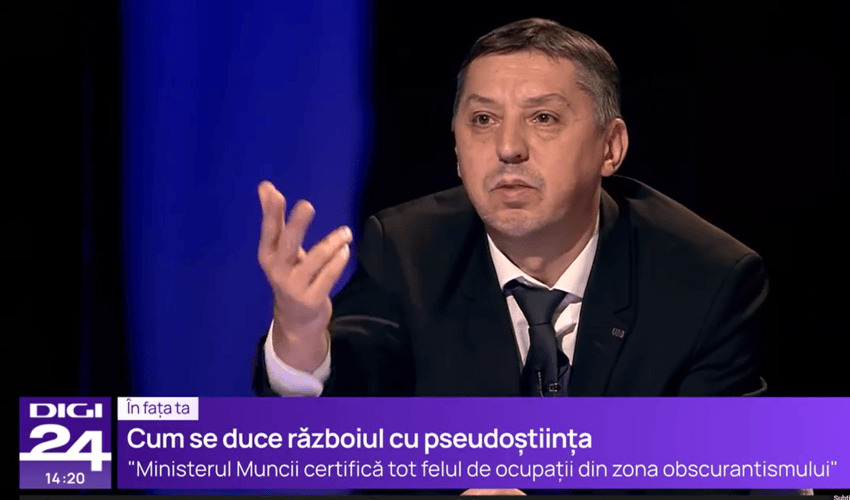
How to Wage the War on Pseudoscience—screenshot from a TV interview in which Romania’s Minister of Education and Research, Daniel David, forcefully rejected the official recognition of astrology as a legitimate profession.
Daniel David is a professor of psychology and the rector of University Babeș-Bolyai from Cluj, Romania. A serious scientist, which is why it was striking to hear him elevate a bureaucratic classification into a diagnosis of the nation’s intellectual decline:
“We are living through a very dangerous moment, one in which the Ministry of Labor is introducing into the labor market all kinds of occupations rooted in obscurantism. The Romanian Psychological Association spoke out, and so did I. It wasn’t easy—the backlash from those we criticized was exactly what you’d expect. I didn’t see any serious reaction from the media. But imagine if ten or twenty universities had joined in, along with the Romanian Academy, and together we had said: ‘People, do you realize how absurd this is? What exactly do you want from a country that officially recognizes astrologers and numerologists as occupations?’ Why are we surprised by these outcomes? Let me put it differently: do you understand that in this country, numerologist and astrologer are now professions officially recognized by the state? Then why are we surprised by our social realities—the PISA results, nostalgia for communism, social polarization, economic polarization…? This is the country we live in.” (on Digi24’s In Fața Ta)
A striking claim: that Romania’s PISA scores, a strange communist nostalgia, its social and economic fractures, can have any connection to a job title on a government list. Every one of those problems has an obvious, well-documented cause, the failures of Romania’s education system, and none of it has anything to do with astrology.
Commenting to an article titled Professor Daniel David’s Revolt, Andrei Tarlea explained what happened:
Professor Daniel David shouldn’t be quite so outraged. Romania’s Classification of Occupations (COR) cannot differ from ISCO, the International Standard Classification of Occupations maintained by the International Labour Organization (ILO), which was established shortly after World War I and became a specialized United Nations agency back in 1946. What better proof is there that COR simply mirrors ISCO than the Romanian Ministry of Labor’s own website?
In short, if Professor David wants his outrage to serve a purpose, it should be directed at the United Nations, through the ILO, which periodically updates ISCO. Only after ISCO is revised does Romania update COR accordingly. If he genuinely believes that Romania invented its own occupational classification independently of ISCO, then he has approached the subject rather superficially.
As for occupations that may be considered “obscurantist,” the reality is that they are recognized by ISCO, the ILO, and ultimately the United Nations. Romania is therefore obliged to recognize them as well.
Rather than expending energy on a futile campaign, Professor David might be better served by developing an educational strategy that shifts the balance toward the sciences from elementary school onward. Given that these occupations already enjoy international recognition, there is no legal basis for eliminating or prohibiting them.
Making too much noise over this issue also comes dangerously close to advocating the suppression of religion. It has been only thirty-four years since the Romanian Orthodox Church, and religion in general, was condemned under the communist propaganda imported from the Soviet Union. Religious belief was dismissed as obscurantism, “the opium of the people,” and Nicolae Ceaușescu ensured that everyone remained at work during every major religious holiday, especially Easter and Christmas.
A useful reminder for those who still look back nostalgically on the communist era. Educators should concern themselves with education—not distractions. And they should do it well, rather than repeating the disappointing story of the much-publicized “Educated Romania” project.
Indeed, David could have spent his energy fixing the system he actually runs. Instead he went looking for a villain, and picked the wrong one. If astrology on a job list could wreck a country’s education outcomes, someone should explain why plenty of nations that recognize the same occupation outperform Romania on PISA tests.
Besides, a tax code is not a manifesto, and recognizing an occupation for administrative purposes is not the same as endorsing its claims. Something might have blurred that distinction for professor David.
Here’s where the story gets funny. The birth chart of David, who sees nothing in astrology but obscurantism, carries an applying Saturn–Neptune aspect. The orb is a loose 13°31′, wide enough to argue about, but life, more than any textbook, is where astrology actually proves itself. He was born near the tail end of that era’s Saturn–Neptune opposition, when the archetypal field was saturated, the way colors linger on the sunset.
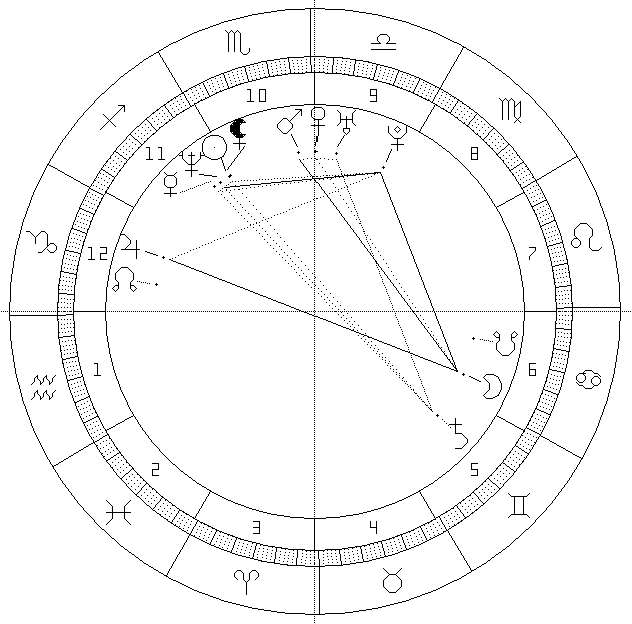
Daniel David November 23, 1972, Satu Mare, Romania (noon chart)
In his essay The Ideal and the Real, Richard Tarnas catalogs a long line of thinkers born under the same configuration, people whose life’s work was the systematic demolition of religious and metaphysical belief:
An equally characteristic motif among individuals born with this same planetary configuration—and equally reflective of this same archetypal polarity—was a definite tendency towards metaphysical skepticism, a seemingly innate proclivity to doubt the existence of transcendent or spiritual realities (Neptune), negating these in favor of the concrete empirical world (Saturn). This tendency often took the form of a strong impulse to demystify religious belief as itself a principal cause of both oppression and illusion in human life.
For example, David Hume, the paradigmatic skeptic of modern philosophy and acute critic of religious belief (On Miracles, Dialogues on Natural Religion) was born with Saturn and Neptune in alignment, as also was Bertrand Russell, his twentieth-century successor (Why I Am Not a Christian). So also was Freud, with his psychoanalytic deconstruction of religious belief—most explicit in The Future of an Illusion, in which all religion is viewed as the psychological residue of childhood projections of parental omnipotence. So too were Darwin, with his scientific dismantling of the biblical understanding of creation, and Marx with his socioeconomic deconstruction of religion (“the opiate of the people”), and also Foucault with his postmodern development of the same tendencies—all born with Saturn and Neptune in alignment.
In the latter group of individuals, the tension between the two corresponding archetypal principles seemed to be resolved through a decisive identification with one side of the polarity (Saturn) in such a way as to require the negation of the other (Neptune). The archetype associated with Saturn, governing the concretely literal and material dimensions of life, as well as the very impulse towards judgment and negation, is here expressed as a commitment to a skeptical common-sense empiricism, strict factual judgment, a fidelity to the demands of the temporal and finite—the naked truth undistorted by emotion or fantasy, a stern negation of whatever is assessed and found wanting. This Saturnian constellation of impulses is expressed as an emphatic denial of the entire archetypal gestalt associated with Neptune—the metaphysical, the spiritual, the supernatural, the transcendent, the timeless and infinite—with these here regarded as naïve illusion and wishful projection, the shadow side of the Neptune principle.
Hume. Russell. Freud. Darwin. Marx. Foucault. Add David to the list, and the pattern holds.
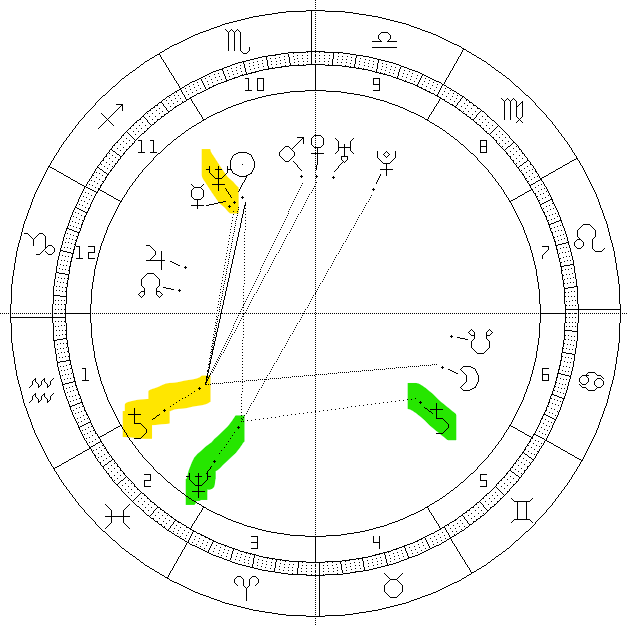
And now the timing: when David launched his campaign, he was living through a rare double Saturn-Neptune transit:
- Transiting Saturn square natal Neptune (yellow)
- Transiting Neptune square natal Saturn (green)
The state’s move to grant astrology (Neptune) formal status inside its labor classification (Saturn) hit that fault line directly. The double transit didn’t create the tension, just amplified something that was already there. What happened next reads like a script written by someone with an unusual sense of humor.
December 23, 2024 (one year after the TV show): David is named Minister of Education in Romania’s interim government.
June 23, 2025: his position as Minister of Education is confirmed under the new government.
June 25, 2025: By request of Ministry of Education, the National Audio-visual Council modified a law imposing a mandatory on-air disclaimer before any program containing astrology: “The information presented in this program has no scientific basis.” Within a couple of weeks, on August 7, Romania passes the only law of its kind on Earth. Not one but both of the law’s key dates, June 25 and August 7, fall inside a global Saturn–Neptune conjunction so tight the planets sit less than half a degree apart.
To resume: at the end of 2024 the state (Saturn) formally recognizes a discipline built on symbolic pattern-reading (Neptune). A man born under a Saturn–Neptune aspect (David) then leads a Saturnian campaign—structure, judgment, official authority—against that same discipline (Neptune), during a double Saturn-Neptune personal transit. It’s the mechanism Tarnas warned us about: someone ignoring the archetypal forces becomes the unconscious puppet through which they express themselves anyway.
A year and a half later, professor David Saturn-Neptune crusade is distilled into policy: official language, imposed structure, judgment, stamped before every astrological program in the country. Signed and imposed under an almost exact Saturn–Neptune world transit. At some point, coincidence stops being the more likely explanation.
And now let’s ask the question David never did: what, exactly, counts as “obscurantist” here—this kind of reading that traces a coherent pattern across a birth chart, a set of transits, the scope and the precise dates of a law? Or the assumption that all of these lined up purely by chance?
Give David his due on one point. Romania’s real problem isn’t astrology, it’s fraud disguised as expertise, and an education system that doesn’t teach people to spot the difference. That problem is bigger than any astrology program, and it shows up in institutions with far higher stakes than an astrological program.
The disclaimer law itself will likely be remembered as exactly that: a footnote next to the discipline it tried to discredit. Astrology has outlasted worse than a mandatory warning label.
That being said, there was a better version of this story available to him. A Minister of Education could have required Romania’s practicing astrologers to complete real training in counseling before working with clients—modest, enforceable, and actually useful to the public he claims to be protecting. That didn’t happen.
Instead, Romania keeps funding its public institutions generously, sometimes lavishly, while those institutions keep returning the same disappointing results, year after year, and everyone has simply learned to live with it. That contradiction, not a job title on a government list, is the expensive problem still sitting there, unsolved. Which might be the sharpest irony in the whole affair: it belongs to the psychology of Romanian people, which is Professor David’s own field of expertise.